
Operating Models, Not Dashboards

Why Dashboards Are a Symptom, Not a Fix
Every data vendor will show you a dashboard. Fewer will tell you the truth about what a dashboard actually is: a symptom. It's the visible proof that, somewhere upstream, someone had a question they couldn't answer themselves and didn’t have a faster path to a solution. A dashboard doesn't fix that. It dresses up the question, gives the answer a nicer home, but it still took significant effort to produce. Build a hundred of them and the underlying problem is still there, wearing a hundred different faces. You can't decorate your way out of a structural problem.
The alternative isn't a better dashboard. It's a different relationship between the app and the spine underneath it. Build the substrate right: one governed source of identity, one place data gets validated and resolved. Do that, and every application built on top of it collapses down to a thin view. Not because the applications get simpler in some cosmetic sense, but because the hard questions are already answered before the app ever renders a pixel. Is this the right number? Is this the current version? Is this actually the same customer as the one in the other system? These questions evaporate when there is inherent trust in the structure. That’s true for the apps that exist today, but also for the apps yet to be built. Sit with that for a second… that's potential for a real 20x reduction. Every other application built on the same governed spine inherits that foundation once built, today and going forward. The spine doesn't just hold up what's already built. It's what makes the next thing, and all future things, cheap.
The Governed Spine, In One Real Number
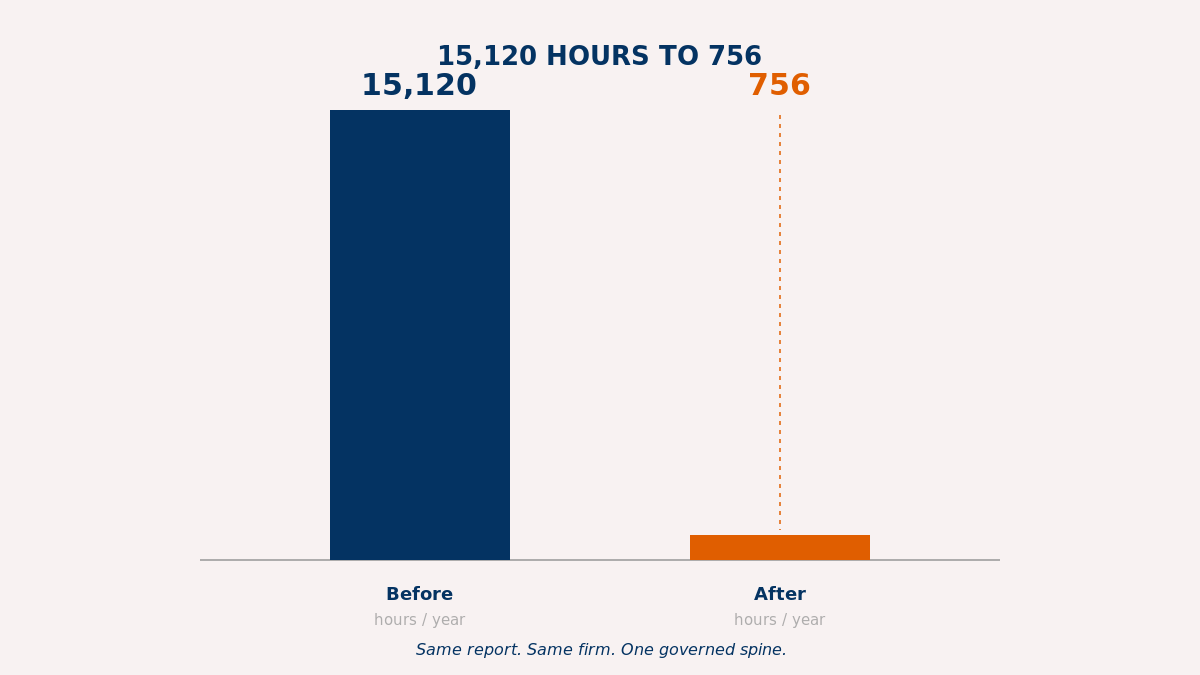
None of this is theoretical or outlandish to claim. One of our recent engagements centered on a private equity firm's single largest recurring deliverable: a twice-yearly, 150-page review covering every portfolio company and every corner of the firm, presented over multiple days in front of the CEO. It consumed roughly 15,120 hours a year to produce across the company, rebuilt every cycle from raw exports. The fix wasn't more people or a bigger reporting team. It was an actual governed spine underneath the reporting. After that rebuild, the number fell to roughly 756 hours a year. The most recent cycle went to the CEO with zero change requests: the first time in the firm's history. Before the rebuild, a report going sideways days before the company-wide meeting cost one team a straight 48-hour rescue situation… and this happened almost every cycle. After building out a data ecosystem with the foundational strength to consistently answer the right questions, that kind of rescue doesn't need to happen again. Not because someone got faster at the rescue or dressed up a dashboard. Because the thing that used to break stopped being capable of breaking that way.
Why More Headcount Didn't Fix It
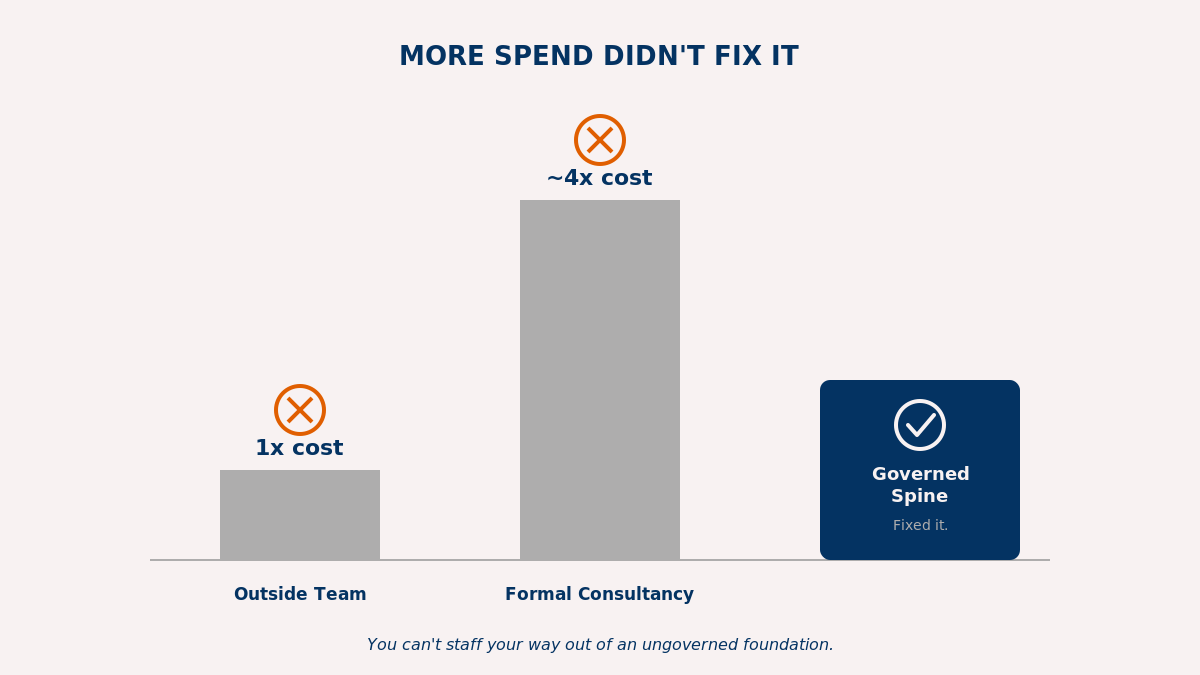
The fix wasn't more people, and that claim is worth backing up with what was actually tried first. Before the governed spine, this firm did what most firms do when a critical process starts breaking: it added people. An outside team was brought in first, to keep the reporting running. When that wasn't enough, the firm engaged a larger, more formal consultancy, at roughly four times the cost of the original team. Both arrangements looked reasonable on paper. Neither held up under the pressure of a fast-moving private equity firm. More headcount didn't fix a structural problem. It just spread the same structural problem across the company, at a higher price. The lesson wasn't subtle: you cannot staff your way out of an ungoverned foundation.
Twenty Workflows That Simply Disappeared
The Firm-Wide Review wasn't the only process rebuilt on that same spine. The firm ran roughly twenty other recurring internal workflows, goal-setting, checkpoint reviews, performance milestones, that had quietly become their own version of the same problem: manual, repetitive, and eating a meaningful chunk of a full week from dozens of people every single cycle. Once those workflows sat on the same governed foundation as the flagship report, they didn't get faster. They disappeared. The people who used to spend a week a month on them aren't spending less time on them today. They aren't involved in them at all. That's the actual signature of a governed system: not that the work speeds up, but that entire categories of work evaporate.
What Actually Changed
Look at what actually changed. A report that ate 15,120 hours a year now takes 756. Twenty other recurring workflows that used to eat a full week of people's time every cycle now run untouched. A cycle that always shipped with a stack of change requests shipped with zero. A rescue that used to eat an entire team for 48 hours before the company-wide meeting stopped happening at all. These all seem like wins, but in fact, they are the evidence that the system is working. The win is a governed data and AI ecosystem with the foundational strength and trust to give the same answer, every time. The hours and dollars saved are just the proof.
From Reclaimed Hours to Deal Capacity
Hours saved is the wrong number to fixate on, though it's the one that's easiest to point to. What actually matters is what that reclaimed time gets converted into, and for a private equity firm, that answer is specific: deal capacity. An associate not rebuilding a spreadsheet is an associate who can run diligence on one more opportunity. A partner not resolving a data dispute before a board meeting is a partner who can take one more call from a broker.
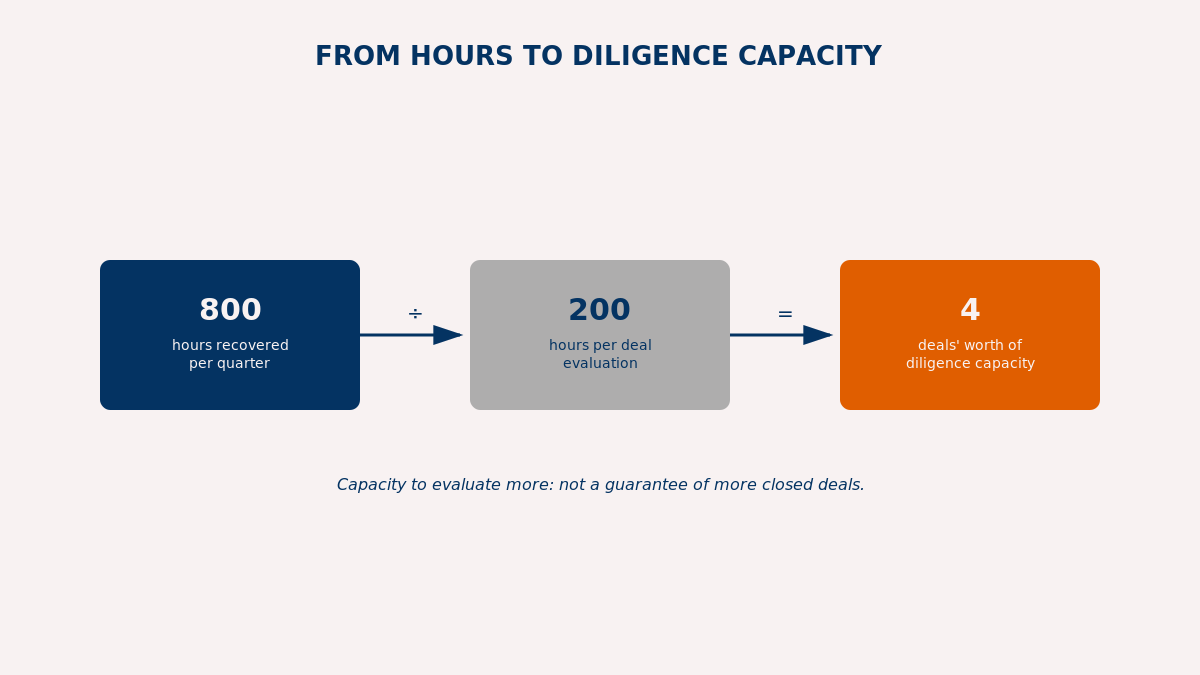
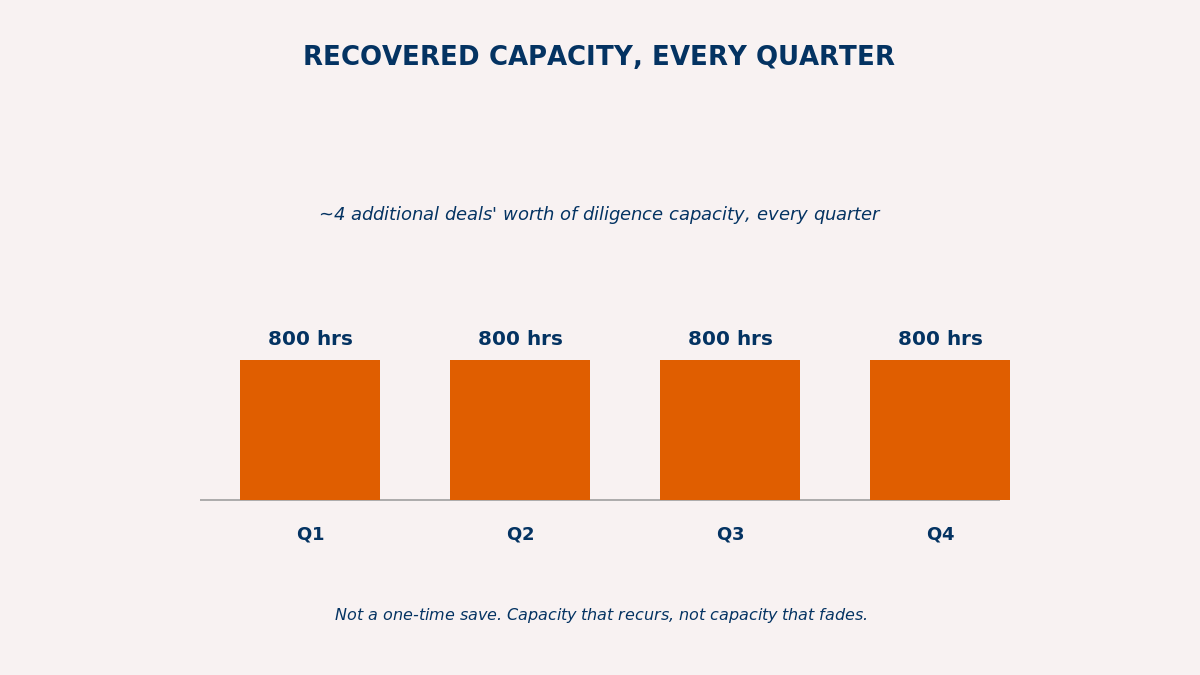
Here's what that looks like with real numbers, from a separate engagement built on the same principle. Freeing up roughly 80 hours per investment team each quarter, held across ten investment teams, works out to 800 hours of recovered capacity every quarter, a little over 3,200 hours a year. A single deal takes an investment team on the order of 200 hours of diligence work to properly evaluate. Run that math and 800 recovered hours a quarter is the staffing equivalent of four additional deals' worth of diligence capacity a quarter, or sixteen a year: opportunities that previously wouldn't have gotten a serious look at all.
Capacity That Recurs, Not Capacity That Fades
For a firm that typically evaluates on the order of 50 deals a year, sixteen additional diligence-worthy opportunities is not a rounding error. And unlike a one-time cost cut, that capacity doesn't disappear after the first quarter. The same team, freed of the same structural drag every quarter, has that capacity back again next quarter, and the quarter after that, because the constraint that used to eat it is actually gone, not just paused.
What This Capacity Is, and Isn't
That's the actual return on a governed foundation, and it's worth being precise about what it is and isn't. It isn't closed deals, and it isn't a guaranteed multiplier on profit. It's capacity: hours that used to be spent proving a number was right, now available to run one more diligence pass, evaluate one more opportunity, take one more call. What a firm does with that capacity is still up to the firm. What the governed foundation does is make sure the capacity exists in the first place, quarter after quarter, instead of getting eaten by the same structural drag every time.
The Same Foundation AI Needs to Be Trusted
It's also the same foundation an AI needs before its answers are worth trusting instead of just fast. Speed without a governed spine underneath it is exactly the problem this series keeps returning to: confident answers that might be wrong, with nobody positioned to tell the difference. The identity and governance work has to happen before either the reporting or the AI is real. Build it once, and both inherit it.
What that frees up is the real argument: not just fewer barriers between a good idea and the moment someone can act on it with confidence, but capacity that doesn't erode again next quarter. A dashboard shop sells you a better window. We build the house.
