
The Toolkit vs. The Product

Who We Are Right Now
Here is the honest version of who we are right now: not a product company, not yet, and not pretending otherwise. What we sell today is a discipline: the way of building a data foundation so it holds under real pressure, and a small senior team that knows how to apply it. That is a smaller claim than a lot of the market makes. It is also the one we can actually stand behind.
What Actually Shows a System Is Well-Built
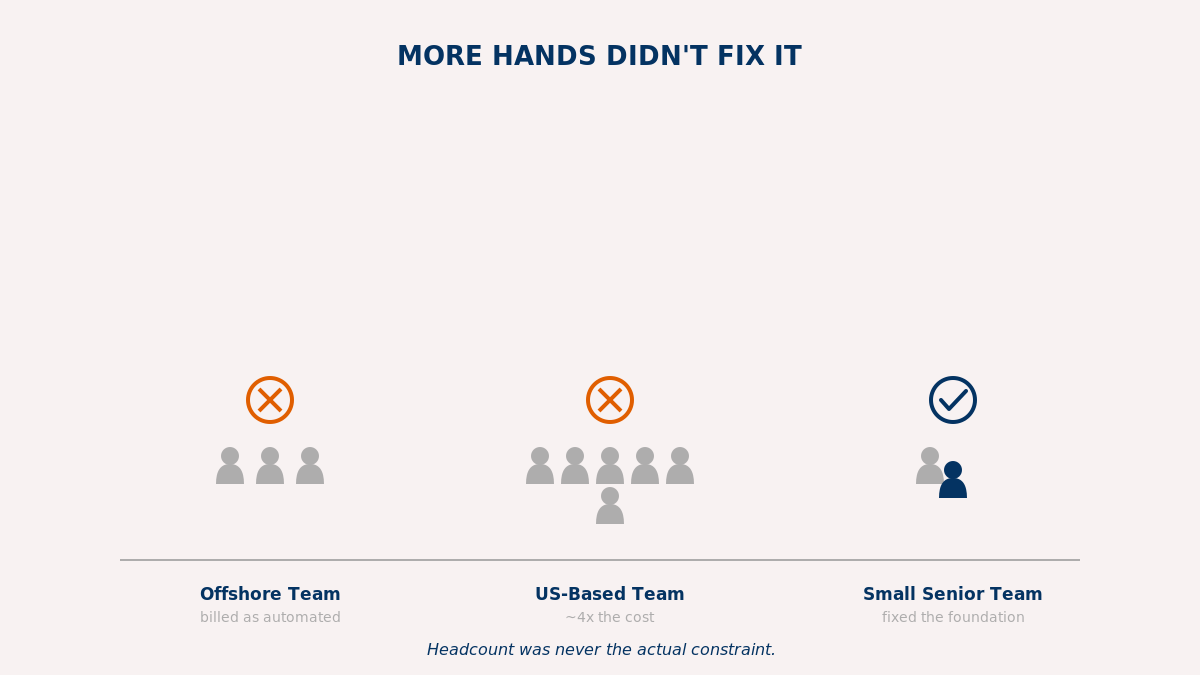
There's a specific way to tell whether a system is actually well-built, and it isn't how sophisticated it looks in a demo. It's how many people it takes to keep running. In one recent engagement, two different teams tried to hold together an ungoverned reporting operation: first an offshore team, then a US-based team brought in at roughly four times the cost. More hands didn't fix it. The problems that mattered — work the offshore team had billed as automated but wasn't, numbers nobody could source, a rescue that ate 48 hours right before a company-wide meeting — didn't move, because headcount was never the actual constraint. You can't out-staff a bad foundation; you either put in the work to fix it, or you keep hiring people to hold up the same cracking dam. A small senior team, working on the architecture itself instead of staffing around its failures, fixed what two larger teams couldn't. That's not a story about effort. It's a story about where the leverage actually sits.
What Our Size Actually Means
That reframes what our own size means. A firm this size isn't a caveat to get past before someone trusts us with real work. It's the shape of firm that can make this argument honestly. Discipline like this doesn't scale by adding more people to watch each other's work; it scales by building the constraint into the foundation, so fewer people are needed to hold it up. We can say that because we're small enough to have actually done it that way, not around it.
Why the Discipline Is the Product
Somewhere down the line, some of what we've built to do this work will be worth putting in front of customers directly. It isn't there yet, and we're not going to dress it up like it is. Right now, the discipline is the product, on purpose — and it's the part of this we will never stop selling, whatever gets built on top of it later.
What the Foundation Frees Everyone Else to Do
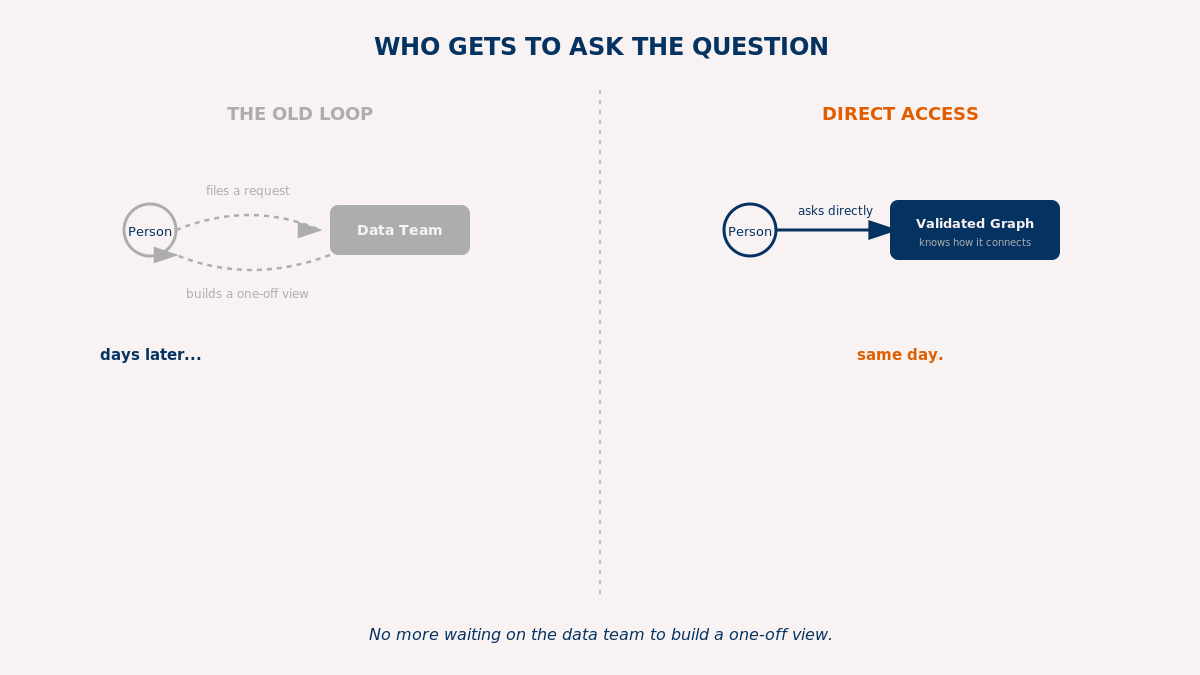
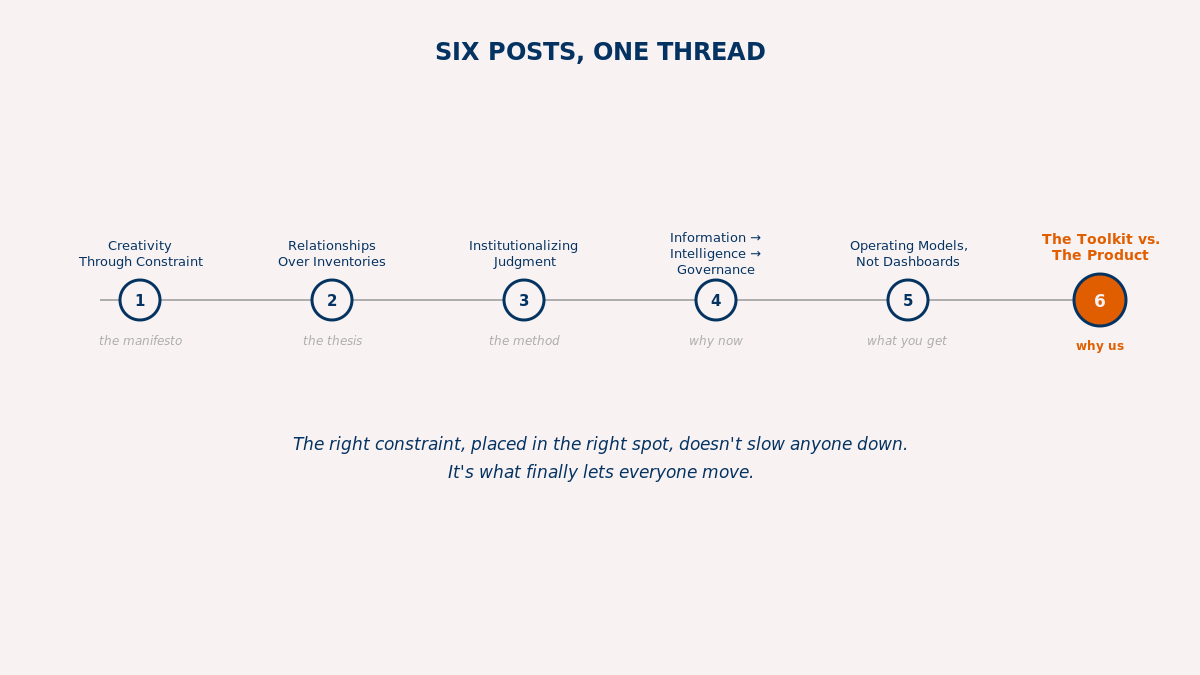
Discipline isn’t really the point, though. Fewer people needed to hold up the foundation is one thing. What matters more is what that foundation frees everyone else to do. When the hard questions are already answered underneath, a person in finance or diligence doesn't have to file a request and wait for someone on the data team to build them a one-off view: they can ask their own question directly, against a source of truth that's already validated: a graph that knows how the pieces connect, not just another accurate list that doesn't. That's not the data team getting faster. That's an entire company getting to test its own hypotheses at the speed AI now makes possible, instead of bottlenecked by the data team's bandwidth. That was the bet from the beginning: the right constraint, placed in the right spot, doesn't slow anyone down. It's what finally lets everyone move.