

Ditch the Spreadsheets: The Roadmap to a Modern, Scalable Data Stack
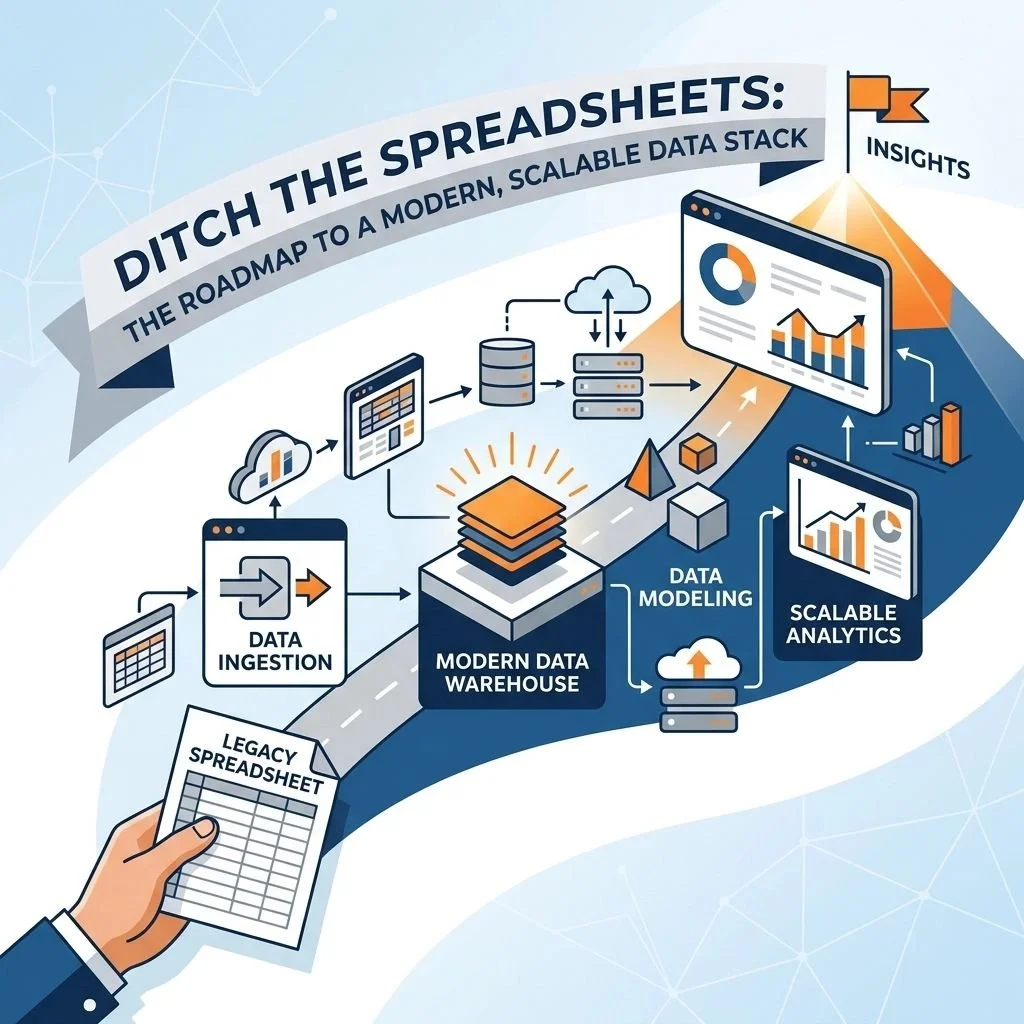
I can’t say we all love spreadsheets, but they are definitely the Swiss Army knife of the business world. You can track a budget, build a project timeline, or calculate your fantasy football league’s standings. But here’s the hard truth, if your company’s entire data strategy is built on a "Final_Final_v3_Actuals.xlsx" file floating around in an email chain, you aren't just behind the curve. You’re standing on a foundation of quick sand.
I’ve seen this movie before. A company grows, the data gets more complex, and suddenly those trusty spreadsheets start breaking. Formulas go haywire. Version control becomes a nightmare. Worst of all, your team is spending hours maintaining the spreadsheet, but nobody actually trusts the numbers.
Moving from legacy silos to a modern cloud architecture isn't just about getting a shiny new tool. It’s about survival in an era where data is the only real competitive advantage left. At Full Score Data, we spend our days helping leaders navigate this transition. Here is the roadmap to finally ditching the spreadsheets and building a stack that actually scales.
The "Spreadsheet Ceiling" and Why You Hit It
The problem isn't that Excel is bad; it’s that it wasn't designed to be a database. When you use spreadsheets as your primary data infrastructure, you hit what I call the "Spreadsheet Ceiling."
1. The "Single Source of Truth" is a Myth
If you have five people in a room and ask for the "Total Revenue" for Q3, and they all pull up different spreadsheets, you’ll get five different answers. One person didn’t include the tax; another used a different currency conversion; a third forgot to filter out the returns. Without a centralized stack, you spend more time arguing about whose numbers are right than actually making decisions. Not to mention the hours of labor that going into maintaining those separate spreadsheets…
2. Zero Scalability
As your data volume grows, your spreadsheets slow down. Eventually, they just stop opening. Even if they do open, trying to run complex analysis on a million rows of data in a local file is a recipe for a crashed laptop and a lot of frustration.
3. The Security Black Hole
Once a spreadsheet is downloaded and emailed, you’ve lost control of it. Sensitive customer data or financial projections can end up anywhere. In a world of GDPR and SOC2 compliance, "Security by Email Attachment" doesn't cut it anymore.
What Does "Modern" Actually Mean?
Before we look at the roadmap, let’s define the destination. A modern data stack isn't a single piece of software. It’s a collection of tools (usually cloud-native), that work together to ingest, store, transform, analyze, and visualize your data.
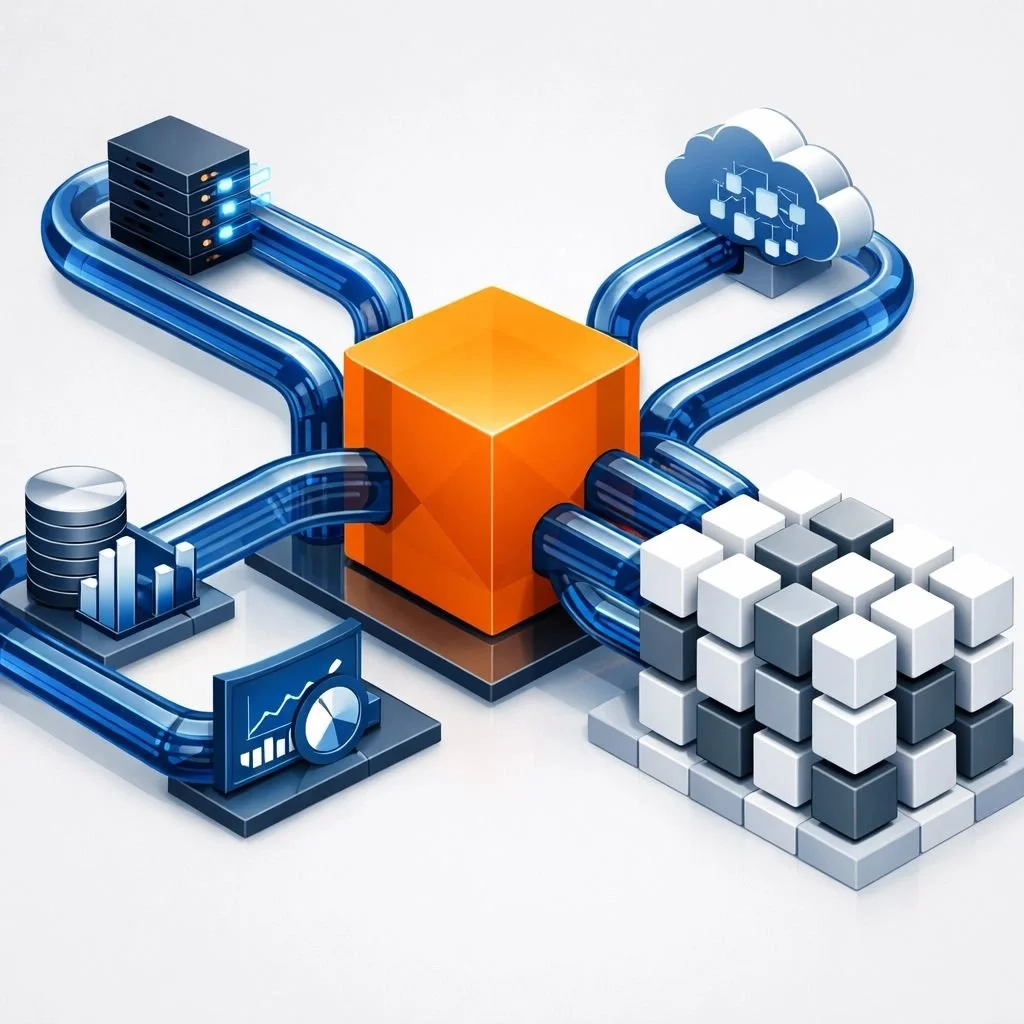
There are many players in the data world, but here are three big players dominating the conversation:
Snowflake: The pioneer of separating storage from compute. It’s incredibly easy to use and scales nearly infinitely.
Databricks: Built on Apache Spark, this is the go-to for heavy-duty data engineering and machine learning. It’s where data lakes and data warehouses meet (the "Lakehouse").
Microsoft Fabric: The "new kid" on the block that integrates everything into the Power BI ecosystem. It’s a great choice if your company is already deep in the Microsoft 365 world.
Regardless of which tool you pick, the goal is the same: Automated, governed, and accessible data.
Phase 1: Strategy Before Shiny Objects
I’ve said it before, and I’ll say it again: Strategy comes before shiny objects.
The biggest mistake I see companies make is buying a Snowflake subscription before they know what problem they are trying to solve. You don’t need a data warehouse just because everyone else has one. You need one because your customer churn is too high and you can't figure out why, or because your supply chain costs are ballooning and the data is buried in five different systems.
Audit your silos. Look at where your data lives. Is it in Salesforce? HubSpot? An on-premise SQL database? Your first job is to map out these sources and identify the "High-Impact Use Cases." Pick one or two specific business questions that, if answered, would move the needle for your bottom line.
Phase 2: Building the Foundation (The PoC)
Don't try to boil the ocean. A "Big Bang" rollout where you try to move every department at once is a guaranteed way to fail. Instead, start small.
Select your core components. You need three things to start:
An Ingestion Tool: Something like Fivetran or Airbyte to "pipe" the data from your sources into your warehouse.
A Cloud Data Warehouse/Lakehouse: This is your central hub (Snowflake, Databricks, etc.).
A Transformation Layer: This is where the magic happens. Tools like Sigma, Tableau, Power BI, or TextQL allow you to turn raw, messy data into clean, usable dashboards.
Run a Proof of Concept. Take one of those high-impact use cases from Phase 1. Build the pipeline for just that data. If you can show the executive team a real-time dashboard that answers a question they’ve been struggling with for years, you’ll get the buy-in you need for the rest of the journey.
Phase 3: The Migration and Data Maturity
Once the foundation is set, it’s time to move the rest of the house. This is where you move away from legacy silos and start centralizing your data assets.
But here’s the thing: moving bad data to a cloud warehouse just gives you expensive bad data. This is why data maturity matters more than AI at this stage. You need to establish:
Naming Conventions: What do we actually call a "Customer"?
Data Governance: Who is allowed to see the salary data?
Quality Checks: How do we know if a pipeline failed this morning?
As you migrate, you’ll realize that the "human" side of data, the definitions and the processes, is much harder to solve than the technical side. That’s okay. It’s part of the process of becoming a data-driven organization.
Phase 4: Scaling and the "AI Effect"
Once your data is clean, centralized, and governed, you’ve reached the fun part. This is where you stop talking about spreadsheets and start talking about predictive analytics and machine learning.
A modern stack is the prerequisite for AI. You can't build a reliable custom LLM or a predictive sales model if your data is trapped in a folder on "Dave from Accounting's" desktop. When your data is in a scalable cloud stack, you can feed it into AI models with a fraction of the effort it used to take.
There is a constant shift in how we talk about this technology. Eventually, we stop calling it AI and just call it "how software works." But that future is only available to companies that have done the hard work of building a modern data stack.
Key Principles for Your New Stack
If you want your new architecture to last more than two years, keep these principles in mind:
Decouple Storage and Compute: This is non-negotiable. It allows you to pay for what you use and scale up for big holiday sales or end-of-month reporting without overpaying during the quiet times.
Modular over Monolithic: Don't buy a single tool that claims to do everything from ingestion to visualization. They usually do everything poorly. Pick "best-in-breed" tools that play well together.
Automate Everything: If a human has to manually click "Export" or "Upload" at any point in your data pipeline, you haven't built a modern stack. You’ve just built a faster spreadsheet.
How Do You Know You’ve Succeeded?
Success isn't just about turning off the old servers. You’ll know you’ve reached the "Modern Data Era" when:
User Adoption Spikes: People actually want to use the data because they trust it.
Latency Drops: You’re looking at data from this morning, not from last month.
Cost Transparency: You know exactly what it costs to generate a specific report.
No More "Shadow IT": People stop building their own rogue spreadsheets because the central system is easier to use.
The Hard Truth
Moving to a modern data stack is a marathon, not a sprint. It requires a shift in culture as much as a shift in technology. You will run into resistance. People will say, "But I like my spreadsheet!"
My advice? Acknowledge their comfort, but show them the light. Show them how much more they can do when they aren't spending four hours a week copying and pasting cells.
If you’re feeling overwhelmed, that’s normal. Most companies are still figuring this out. The key is to start small, stay focused on business value, and build for the future. Don't let your data be a liability held together by formulas and prayers. Turn it into the asset it was meant to be.
