

In 1908, Arnold Schoenberg gave up on tonality. For two hundred years, Western composition had lived inside a strict grammar: a home key, a hierarchy of chords pulling back toward it, rules about which note could follow which. Schoenberg broke the grammar. Every note became equally available, equally free. It should have felt like liberation. Within a few years, it felt like a crisis — without a center to pull against, freedom didn’t produce more interesting music. It produced music that even Schoenberg heard as arbitrary. Total freedom had collapsed into entropy.
His answer wasn’t to go back. It was to go forward with a harder rule. In the early 1920s he built the twelve-tone technique: all twelve notes had to appear, in a fixed row, before any could repeat. It’s a stricter constraint than tonality ever imposed, and it’s what let him write coherently again. The constraint wasn’t the cost of the freedom. It was the thing that made the freedom usable.
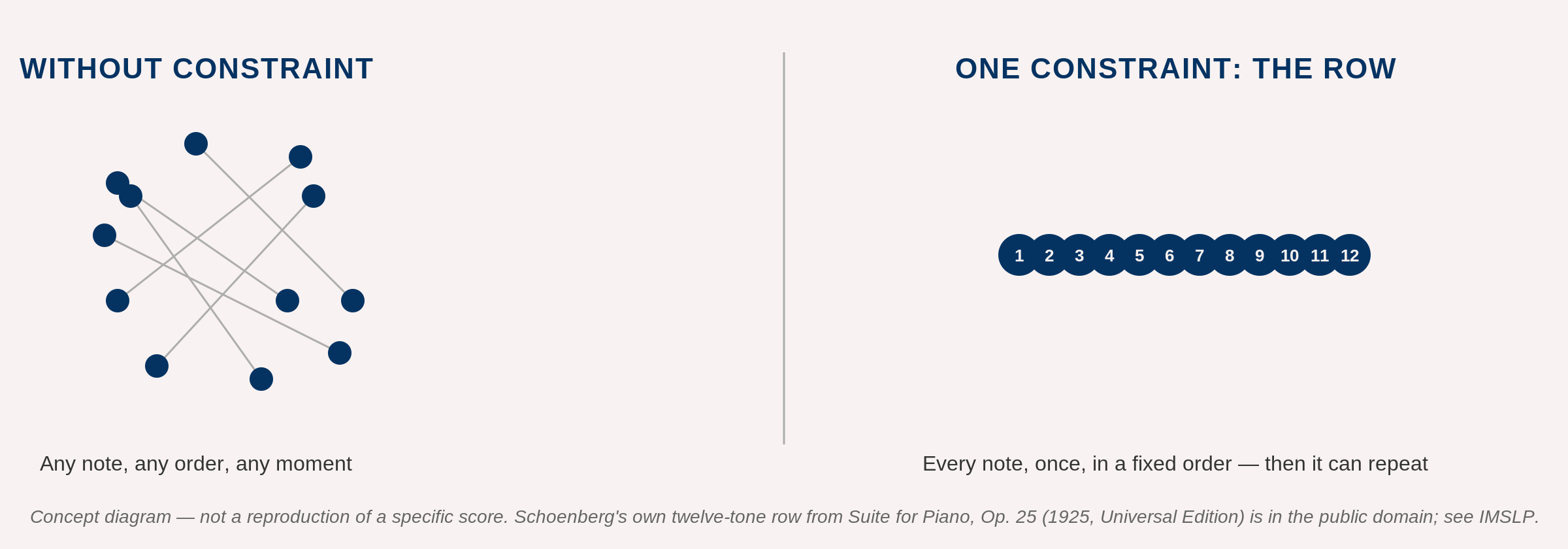 Concept diagram, not a reproduction of a specific score — Schoenberg’s own row, from Suite for Piano, Op. 25 (1925), is public domain and viewable via IMSLP.
Tom McCullough, Managing Partner at Full Score Data Solutions, first started running into this law decades before there was a data company to build it into. He didn’t have a name for it yet.
He kept finding the same law outside the concert hall. At the cello, the instrument itself is the constraint — four strings, fixed tuning — and a specific, deliberate fingering choice is what turns a difficult passage into a musical one instead of merely a correct one. At the woodworking bench, committing to one joint and one set of hand tools for a piece is what forces an actual decision, instead of leaving every option permanently open. Three domains, one law, before data ever entered the picture: unlimited choice doesn’t produce quality. A chosen limitation does.
The fourth domain is where the law stopped being personal and became a business — and where it finally got a name. Watching the same pattern surface again and again in client data work, unmistakable enough to name: Creativity Through Constraint. Not a phrase borrowed later for a pitch deck. The name the pattern had been waiting on.
Here’s the one constraint that actually matters in a data organization: one identity per entity, decided the moment the data walks in the door. When a new customer, deal, or portfolio company enters the data estate, it gets exactly one record, and that record’s identity is resolved once — at the moment the data arrives — not silently re-guessed every time a different report joins it to something else. That sounds small. It isn’t. The normal alternative is that the sales system assigns its own ID, finance assigns another, the reporting layer takes its best guess at matching them, and every downstream number quietly inherits some uncertainty about whether it’s even describing the same thing twice. Nobody catches that with a bigger validation step later. It has to be foreclosed at the start, or it never gets foreclosed at all.
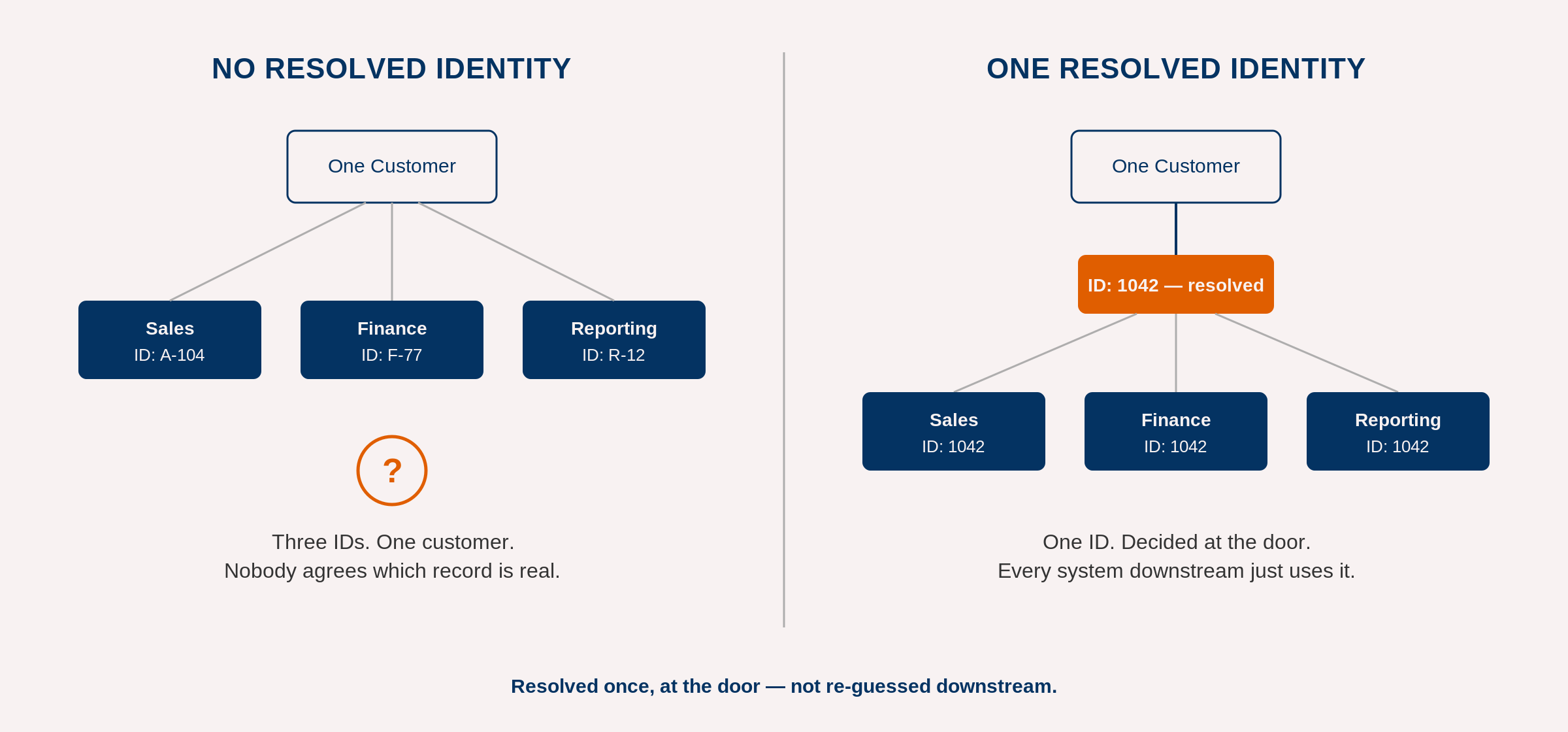 Three systems, three guesses vs. one identity, resolved once at the door.
That one rule — chosen and enforced the moment data enters, instead of argued about after it’s already spread through a dozen reports — is what makes everything downstream safe to build quickly. Not because the constraint is clever. Because it’s decided once, instead of re-litigated every time someone needs an answer. Get it right at the door, and nobody’s mopping up the mess three systems downstream.
Same law as the twelve-tone row. Restricting the order didn’t restrict the music — it’s what made the music possible to write at all. Restricting identity to one resolved answer per entity doesn’t restrict a data organization. It’s what makes everything built on top of it trustworthy enough to move fast.
And trust is the actual product of that constraint, not a side effect of it. Trust isn’t a policy you publish or a badge you put on a slide. It’s what happens when the same question gets the same answer every time somebody asks it — this quarter, next quarter, from finance, from the deal team, from the board. The moment identity gets re-guessed report to report, every number carries a silent asterisk, and people start double-checking things they should be able to just use. Foreclose that guess once, at the door, and the asterisk disappears. That’s the whole trade: one constraint, enforced early, in exchange for a business that can actually believe its own data.
That’s why it isn’t a slogan someone picked. It’s what the pattern named itself, once it became unmistakable. Not a flourish. The operating principle.