
Full Score Data Solutions

Unlock the Full Score

Two pillars of Creativity Through Constraint are open below. Unlock the rest — Tempo, Music, and Proof — with your email.

The complete five-pillar argument, plus an annotated score you can hand to your own team.

Creativity Through Constraint rests on five pillars: Instrument, Discipline, Tempo, Music, and Proof. The first two — the constraints themselves — are open below. The rest is what those constraints buy back: speed, trust, and proof it holds under real pressure.

Tap a note to explore that pillar

One hub. One identity per entity.

The Instrument

Most data organizations build inventories when what they need is relationships. An inventory tells you what tables and fields exist. It doesn’t tell you how they connect — to each other, or to the people relying on them. That missing map, not a missing system, is the root of almost every symptom a data org has: the report nobody trusts, the number that takes three people to verify, the AI tool nobody dares hand a real decision.

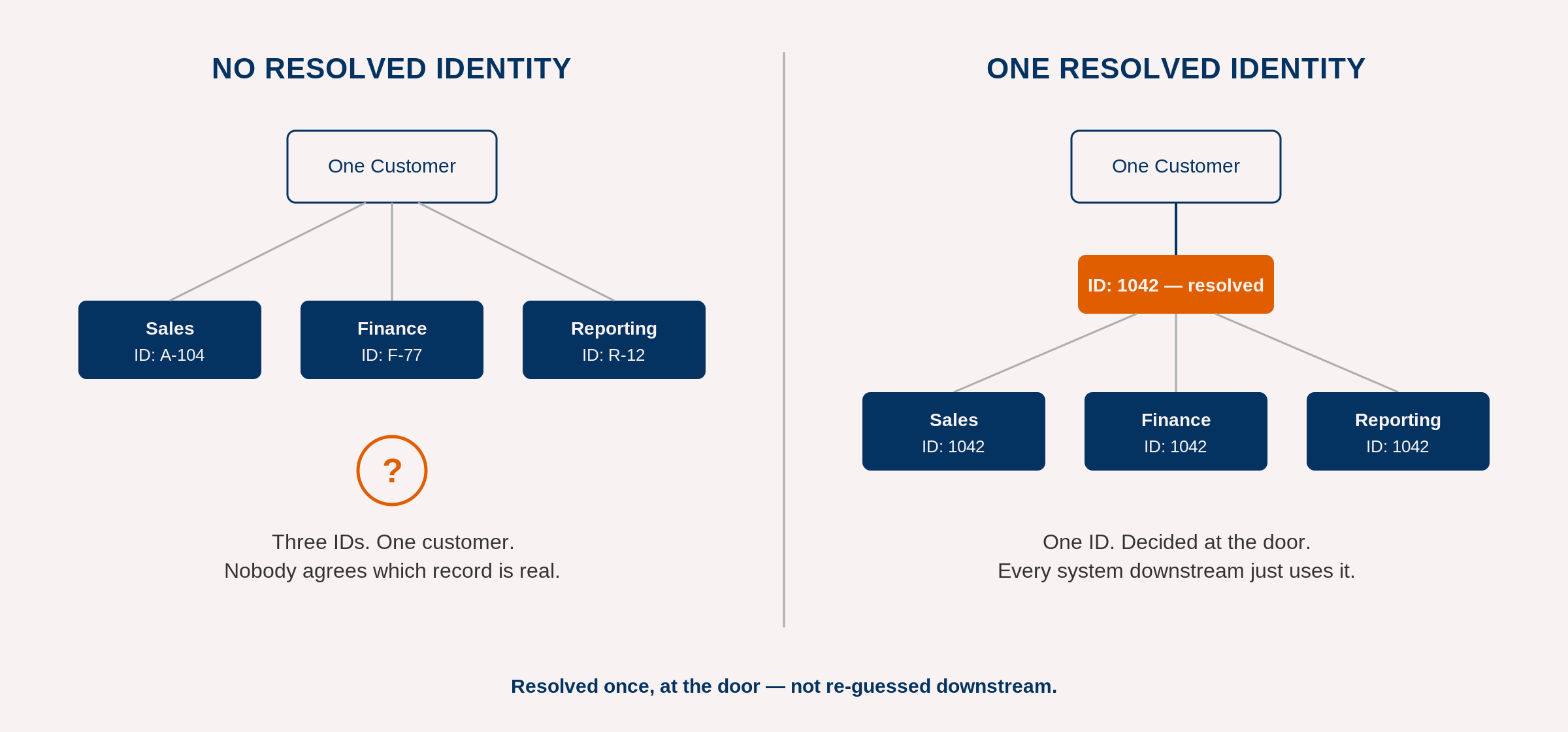
The instrument is the fix: every source feeds a single governed hub, where every person, account, or asset is defined exactly once. Not a bigger inventory of systems — one place where identity gets decided, instead of a dozen disconnected systems each guessing at it.

This is the first of two deliberate constraints, chosen on purpose, not adopted as architecture for its own sake. Fewer, sharper constraints don’t restrict the system — they buy the freedom on the other side of it.
“An inventory tells you what data exists. The relationships tell you what it means, where it came from, and whether it can be trusted.”
Diagram showing sales, finance, and reporting systems each assigning a different ID to the same entity on the left, versus one identity resolved once and flowing consistently to all three systems on the right.